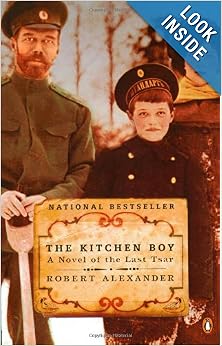
This book is an excellent piece of historical fiction. Even though my eyes got really, really tired, I kept wanting to read "just one more chapter" so I could see what happened next. The author truly is a storyteller. While I knew nothing (seriously, nothing at all. I knew nothing about the Romanov family--there is so much to learn and so little time!) about this time period, the country of Russia, or the real-live people who are characters in this book, The Kitchen Boy piqued my curiosity and motivated me to learn a little. It's always enjoyable when an author stays true to true events of a revolution, the last Tsar and his family (down to the haemophilia) and even the disreputable mystic-faith-healing Rasputin. (fascinating! It really is!) And then when he takes a real-life mystery and speculates on what possibly happened. . .well, that's just fun!
I also enjoyed his commentary about the time period, the ingredients that resulted in the collapse of the Russian dynasty, and his insight into the character and motivations of historical figures:
"A great curse was unleashed that night, inundating every corner of his vast homeland. If his comrades could commit such an act, was it any wonder that Stalin could kill upward of twenty million of his own people? No, of course not. On a hot night in the Siberian city of Yekaterinburg the individual had become expendable" (4).You'll likely want to read Carrie's review, as it's much more articulate than mine and she is the friend who kindly recommended it to me. I think I'm going to have to read the next two books Alexander wrote about this time period!
"But in fact. . .in fact the dynasty itself exploded for a myriad or stupidly brilliant reasons. Simply, it somehow stumbled upon a perfect, and yet altogether not random, chemical reaction: you take one part decent man but not enlightened ruler, one part heartbroken mother clutching for any way to save her son, two parts inbred dynasty and gossip-obsessed court, one part Great War, and three parts uneducated, worn, and hungry people and-boom!-what do you get? Revolution, terrible, terrible revolution, of course!. . .literally overnight a three-hundred-year old dynasty evaporated-poof, gone!-with no one lifting a finger to save it. Ironic that the Soviet Union collapsed just as easily, which proves it was no better, that the cure, kommunizm, was in fact far worse than the disease itself" (92).
"Bloodshed was not at all what he wanted. . .and yet any fool would admit that that was his legacy. When Batyushka, the Dear Father, departed this world, he left behind a vast sea of blood, his own, his family's, his country's. Up until the ironfisted, totalitarian rule of the Red tsars--the kommunisty, who made the terrible Ivan look like a choir boy-his reign was one of the most violent in all the history of Russia. One must not forget that it was during the reign of Nicholas II that two disastrous wars, two bitter revolutions, and countless pogroms befell Holy Mother Russia. And thought Tsar Nikolai wanted nothing more than to avoid violence, though many of the disasters were not of his doing, virtually all of them were his fault because he was Tsar, Russian Tsar, absolute Tsar, Orthodox Tsar. When you look back through the decades, it now seems utterly obvious that there was no way it could be done, no way an autocrat could rule so vast a country, at least not without complete terror and oppression" (73).

Done- just reserved it from our library. You are a terrible/fantastic influence.
ReplyDeleteHa! Blame it on Carrie! I hope you get some time to read and review it--I'm sure your review would be much more coherent than mine. :)
DeleteI remember Carrie's review and wanted to read this one then. Thanks for the reminder!
ReplyDelete