"I think everybody needs to read it." --Destry
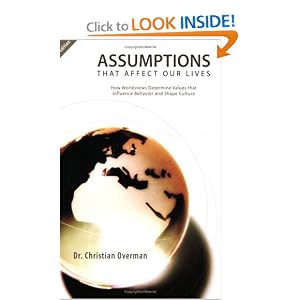
I read Assumptions That Affect Our Lives: How Worldviews Determine Values that Influence Behavior and Shape Culture by Dr. Christian Overman with my teens this past school year. This book is so outstanding, it's one of those I have a hard time reviewing. I agree with Destry; my temptation is to just say go get this book right now and read it. Period.
Why are you still here reading this review? Do you need further convincing? Let's see if I can organize my racing brain.
This book is written from the premise that we all have certain assumptions--a pattern of thought, if you will--that shape what we believe and how we live. Many times we don't even examine why we believe what we believe, or how our beliefs are affecting the choices we make. This book breaks down how the choices we are making, both as individuals and as a culture, are revealing underlying beliefs.
It's a bit scary.
This is a huge topic, but Dr. Overman did a wonderful job making it easier to understand (his acknowledgements give credit to his wife for 'reviewing the manuscript with an eye for understandability for everyday people', so I am also grateful to her). He breaks it down into its most basic form as a comparison between Hebraic thought (that of those people who believed in God and attempted to follow His commandments) and Greek thought (in which people believe there is no absolute truth and worship the created rather than the Creator). He shows that our belief system is something like a map, and if our map is flawed, we simply won't reach our destination. It doesn't matter how talented we are, how hard we work, how sincerely we are attempting to arrive if our map is flawed.
Now aren't you ready to check this book out so you can examine your map? This is serious business.
Overman challenges us to a history quiz. "What time and place in history do the following statements describe?
- People, especially the educated ones, have rejected traditional religion.
- The upper class is consumed with the pursuit of pleasure.
- Education stresses knowledge more than character, and produces masses of half-educated people.
- Public athletic games have turned into professional contests.
- Homosexuality is popular.
- Men who want to watch dances by unclad women do not have to go far to find them.
- The dramas of the day are full of seduction and adultery.
- A women's liberation movement has brought women into active roles in a previously male-oriented culture.
- Motherhood is devalued, and the bearing of children is viewed as an inconvenience.
- Abortion is commonly practiced, as well as infanticide.
The similarities between decadent Greece and present day America are stark and sobering. Even more sobering is the fact that many of these descriptions so fitting for America today would have been unthinkable just two generations ago. We've come a long way in a short time. The descriptions of ancient Greece listed above are those given by historian Will Durant in his well-known book, The Life of Greece, published in 1939. He writes about these characteristics of Greek culture near the latter part of the book, in a subsection entitled, "The Morals of Decay." This was Greece near the end of her life" (20, emphasis mine).Briana shares her favorite idea she took from the book: "There is no such thing as secular. There is no area that God is not present in. As Colossians says, in Him all things exist and hold together. Instead of secular and spiritual dividers, we should designate things as either natural or supernatural; God is present in both." I thought this was a great lesson for her to retain, especially considering our tendency to "compartmentalize" God and our belief in Him. It's tempting to relegate God to Sunday and think education, employment, relationships, government, etc. somehow operate independently of Him.
"It all has to do with thinking. What was once unthinkable, became acceptable thought. And what is accepted thought, sooner or later is acted out. Our assumptions have changed. What most Americans assumed years ago to be true about ourselves and our offspring, many no longer hold to be true. There has been a large scale shift of assumptions about who we are and what determines our values. At the present time in our history, many Americans have assimilated those same assumptions held by the ancient Greeks that allowed a few Nazi Germans to justify the elimination of bed-wetters. These very same assumptions are now allowing a multitude of apple-pie-eating Americans to eliminate 4,000 pre-born children a day, before they have an opportunity to sleep in a bed, let alone wet one" (70).
I could go on and on about the tons of information packed into this book. I could have written a blog post responding to each chapter if I had just had the time. It's really that good. What are you waiting for? wink, (and no I don't receive a commission, I just think it's that great).

Ok, after I read "The Hole in the Gospel" with the teens, I think that is next. Sounds awesome!
ReplyDeleteYay! It really is--I think you and your kiddos will love it as much as we did!
DeleteI'm totally sold by the title alone. Your words just added flame to the fire! ;D YES! Exactly!
ReplyDeleteHee, hee, can't wait to read your review! It's absolutely worth a week-long process.
DeleteI have to admit, reading the title of the book almost made me turn away; it sounded kind of boring. But your review has convinced me. It's going on my summer reading list.
ReplyDeleteIt's not a "fun" or light read, but it's powerful and enlightening. Can't wait to see what you think of it!
Delete